"As architects, we like to have as many design options as possible when designing a residential or commercial project. Cedar shakes & shingles provide a unique solution that embodies the rich characteristics of wood, that only wood provides. Today we specify type C and B in Colorado for all applications due to their fire retardant properties and UBC code compliance."

Steven M. Lane Architect
AIA Kephart Architects


  Cedar Shake Installation
In shake application, spaced sheathing is usually 1" x 6" boards spaced on centers equal to the weather exposure at which the shakes are to be laid - but never more than 7½" for 18" shakes and 10" for 24" shakes on roof installations.

When 1" x 4" spaced sheathing is installed at 10" on center, additional 1" x 4" boards must be installed between the sheathing boards. A solid deck is recommended in areas where wind-driven snow is encountered.

Roofing felt interlay between the shake courses is required - whether the sheathing is spaced or solid. The felt interlay acts as a baffle that prevents wind-driven snow or other foreign material from entering the attic cavity during extreme weather conditions. The interlays also increase the roof's insulation value.

Special care should be taken when installing the felt interlays over spaced sheathing. This will ensure that an effective baffle is formed (Figure 3). The felt should be applied over the top portion of the shakes and extend on to the spaced sheathing. Position the bottom edge of the felt at a distance above the butt equal to twice the weather exposure.

To be an effective baffle, the top of the felt must rest on the sheathing. The shakes should be placed so that the nails are driven through the upper portion of the sheathing board with the top of the roofing felt attached to the lower portion.


Shake Application

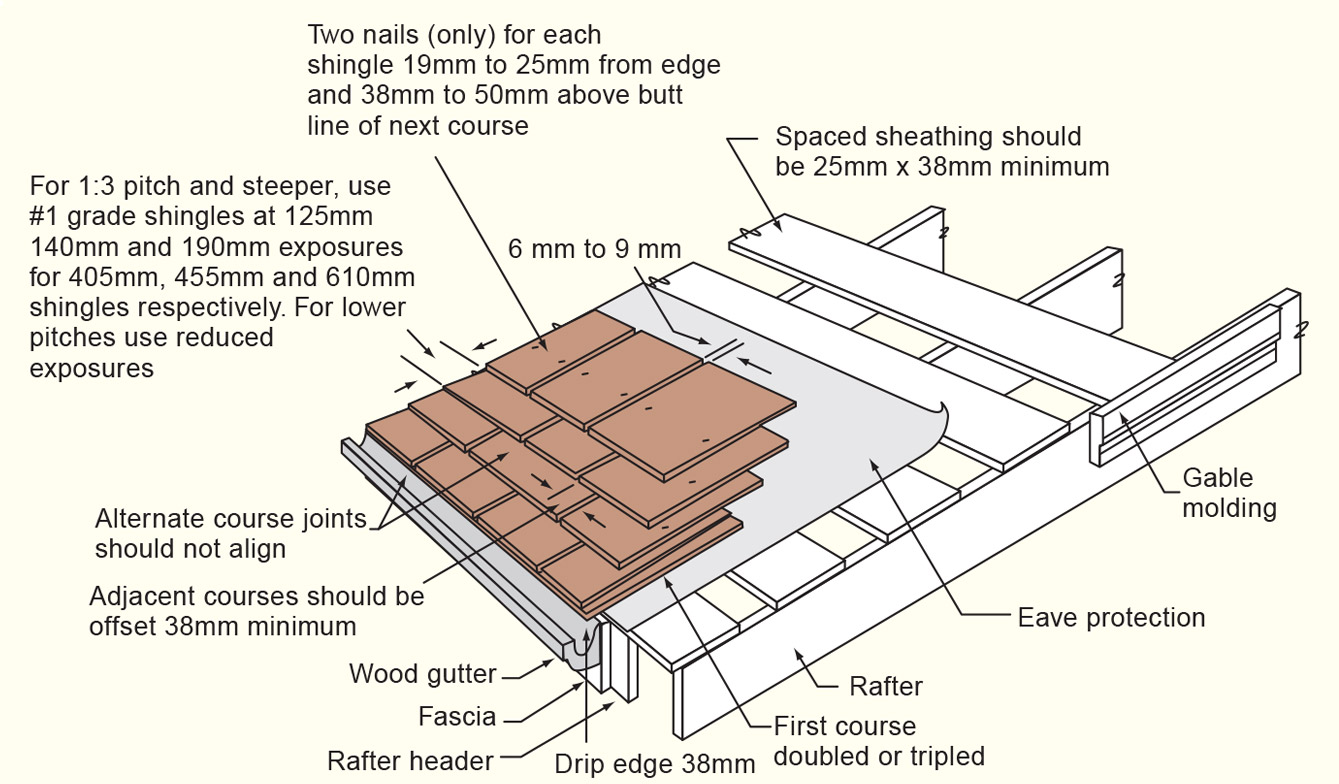
Shakes, like shingles, are normally applied in straight, single courses. The following application details (Figure 5 below) must be observed:

  1. The starter course may be one or two layers of cedar shingles or shakes overlaid with the desired shake. A 15" shake is made expressly for starter and finish courses.

  2. Butts of first course shakes should project 1½" beyond the fascia.

  3. An 18" wide strip of No. 30 roofing felt (or No. 15 felt depending upon code requirements) should be laid over the top portion of the shakes and extend on to the sheathing. The bottom edge of the felt should be positioned above the butt of the shake at a distance equal to twice the weather exposure. For example, 24" shakes laid with 10" exposure would have felt applied 20" above the butt. The felt will cover the top 4" of the shakes and extend up 14" onto the sheathing.

  4. Spacing between adjacent shakes should be a minimum of 3/8" and a maximum of 5/8".

  5. Joints between shakes should be offset 1½" over adjacent courses.

  6. Straight-split shakes should be laid with the froe-end (the end from which the shake has been split and which is smoother) towards the ridge.


Application Instructions for applying Watkins Cedar Shakes as a Class "A" Roof Covering.
(58Kb PDF)

Application Instructions for applying Watkins Cedar Shakes as a Class "C" or "B" Roof Covering. (57Kb PDF)

Shake and Shingle Application Handbook (3.5MB PDF) which includes:

  • Product Description
  • General Roof Design Details
  • Mansard Roof Details
  • Low Slope Roof Details
  • Hip and Ridge Details
  • Roof Juncture Details
  • Roof Valley Flashing Details
  • Roof Projection Flashing Details
  • Ventilation Details
  • Vapor Barrier Guidelines
  • Specialty Roof Deck Details
  • Cold Weather Roof System Details
  • General Wall Design Details
  • Coverage and Exposure Tables