"As architects, we like to have as many design options as possible when designing a residential or commercial project. Cedar shakes & shingles provide a unique solution that embodies the rich characteristics of wood, that only wood provides. Today we specify type C and B in Colorado for all applications due to their fire retardant properties and UBC code compliance."

Steven M. Lane Architect
AIA Kephart Architects


  Cedar Shingle Installation

There are two acceptable methods for application of spaced sheathing.

One is to space 1" x 4" boards to coincide with the weather exposure of the shingles (Figure 1). Thus, if the shingles are to be laid at 5½" to the weather, the sheathing boards would also be spaced at 5½" on center. In this method of application each shingle is nailed to the center of the 1" x 4" board.

In the second method of application, where 1" x 6" boards are used, two courses of shingles are nailed to each 1" x 6" board. (Figure 2) up to and including 5½" weather exposure. Although not commonly used, breather-type underlayment, such as roofing felt, may be applied over either solid or spaced sheathing.


Shingle Application
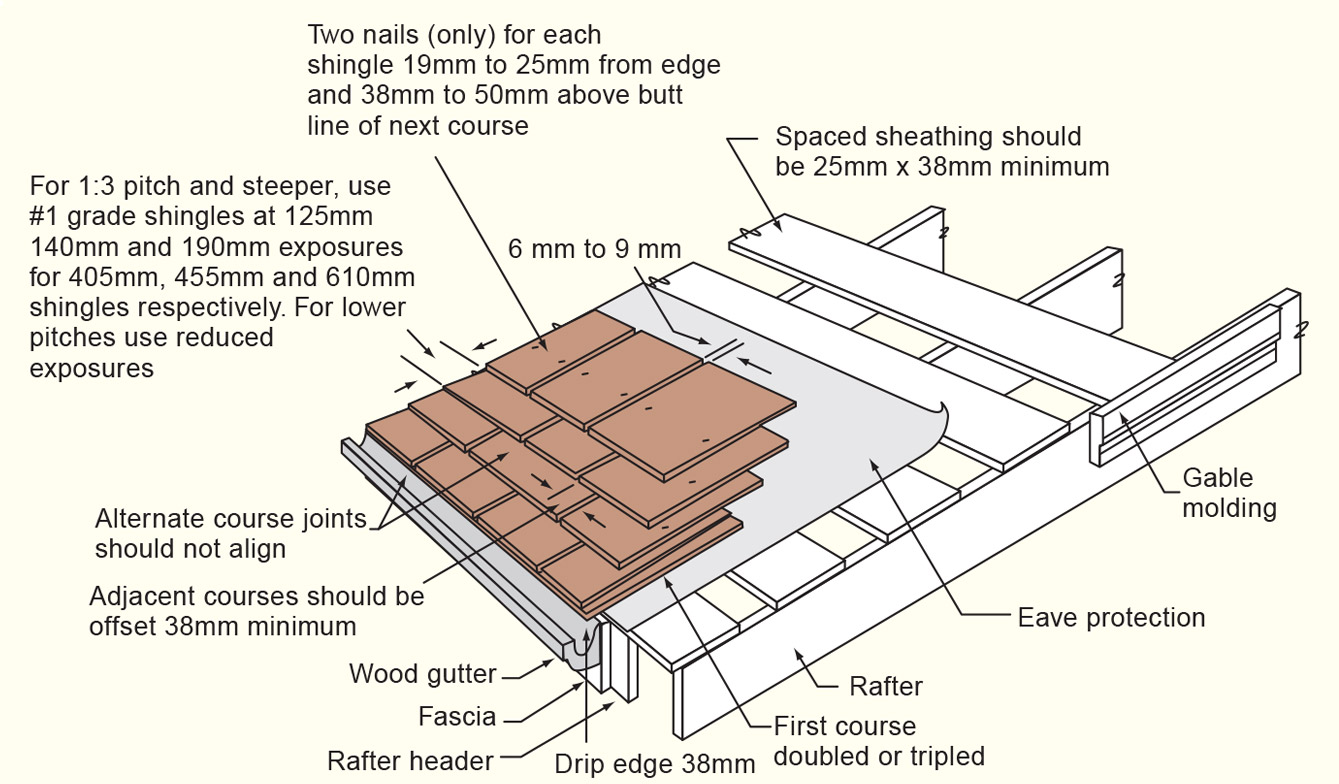
Regardless of style, the following basic application details (Figure 4 below must be observed.)

1) Shingles must be doubled or tripled at all eaves.

2) Butts of first course shingles should project 1½" beyond the fascia.

3) Spacing between adjacent shingles (joints) should be a minimum of ¼" and a maximum of 3/8".

4) Joints in any one course should be separated not less than ½" from joints in adjacent courses; and in any three courses, no two joints should be in direct alignment.

5) In lesser grade shingles containing both flat and vertical grain, joints should not be aligned with centerline of heart.

6) Flat grain shingles wider than 8" should be split in two before nailing. Knots and similar defects should be treated as the edge of the shingle and the joint in the course above placed 1½" from the edge of the defect.


Application Instructions for applying Watkins Cedar Shingles as a Class "A" Roof Covering. (49Kb PDF)

Application Instructions for applying Watkins Cedar Shingles as a Class "C" or "B" Roof Covering. (49Kb PDF)

Shake and Shingle Application Handbook (3.5MB PDF) which includes:

  • Product Description
  • General Roof Design Details
  • Mansard Roof Details
  • Low Slope Roof Details
  • Hip and Ridge Details
  • Roof Juncture Details
  • Roof Valley Flashing Details
  • Roof Projection Flashing Details
  • Ventilation Details
  • Vapor Barrier Guidelines
  • Specialty Roof Deck Details
  • Cold Weather Roof System Details
  • General Wall Design Details
  • Coverage and Exposure Tables